Do our economic models work for industry policy?

The impetus to review the most common schools of economic thought originate in the way the world we live in has changed from a policy perspective since the origination of some of these schools of thought. We find that as complexity increases in the policy domain it becomes more important that capability is held in all the different economic schools and lenses. Hence our interest in understanding the potential usefulness of the different economic schools of thought in policy formulation.

The policies we chose are a function of the issues we see and in the industry policy domain these issues are shaped by the economic lenses we use to observe the world. It is therefore important to understand the differences between these lenses so that we can understand whether a given lens is appropriate in a given situation and context and also so that we can understand the differences in assumptions that underpin the different economic lenses.

It is important to note that models are simplified and abstract representations of a complex underlying reality. As a consequence, it is important to be fully informed of the simplifying assumptions made to enable the mathematical model to be developed. When models are unthinkingly applied, alternatively misused or abused as a consequence of not fully understanding the limitations of the model, the consequence, in the public sphere, is frequently policy failure. What has to be kept in mind is that essentially “all models are wrong but some are useful”.

In this paper we compare the six most commonly used economic lenses: Neo-Classical; Neo-Keynesian; Neo-Schumpeterian; Evolutionary, Institutional and Complexity as well as looking at the emerging lens of Economic Complexity.

The impetus to review the most common schools of economic thought originate in the way the world we live in has changed from a policy perspective since the origination of some of these schools of thought. The evidence based policy paradigm that have so characterized the last decades is being increasingly challenged by a world where facts are uncertain, values in dispute, stakes high and decisions urgent.

We find that as complexity increases in the policy domain it becomes more important that capability is held in all the different economic schools and lenses to align with Ashby’s Law of Requisite variety. This law applies to any system, whether economic, social, mechanical or biological. It has practical relevance for systems that need to survive and grow in uncertain, turbulent environments and it is central to the design of governance systems. It has been claimed that Ashby’s Law is as fundamental to the disciplines of management and economics as Newton’s Laws are to physics.

This also has some practical implications for the role of government. In our context this means that the individuals involved in the policy related activities should have a higher level of diversity in their mental models the higher the complexity of the policy domain (and these different mental models should of course be useful, representations of the underlying complex reality).

Hence our interest in understanding the potential usefulness of the different economic schools of thought. Main insights around each economic school of thought are briefly summarised below

1. Neoclassical economics. This school of thought minimises the role of innovation in growth and government’s capability to spur innovation and largely advices policymakers to manage the business cycle, reduce allocation inefficiencies, and support greater fairness. It assumes that people have rational preferences between outcomes that can be identified and associated with values; that individuals maximize utility and firms maximize profits; and that people act independently on the basis of full and relevant information.

In the presented policy challenge context however, these assumptions cannot be said to be fulfilled and hence this lens should not be used.

2. Keynesian Economics. The focus is on restoring economic output to levels compatible with full employment. The main policy target is the (aggregate) demand side of the economy. The main policy instruments are fiscal and monetary policy. The policy focus on aggregate demand assumes that supply will respond to demand. Thus, there is little attention paid to the role or impact of innovation. These assumptions differ from those in the neo-classical world primarily in the assumptions of sticky prices and wages and imperfect competition.

In the presented policy challenge context the underlying assumptions can be said to be, at best, partly fulfilled and in addition the policy tools at the disposal of a state government would only be able to impact the public sector component of the economy. Hence this lens should only be used within the boundary of the public sector.

3. Neo-Schumpeterian economics is about facilitating investment in knowledge-creating activities, such as research and education, and to encourage agents of change, or entrepreneurs, to innovate. This leads to a wide range of policy targets and instruments with a balance between supply and demand side. The assumptions differ on almost all points from the neo-classical lens and assumes heterogeneous agents with bounded rationality and hence, individuals and firms are not rational maximisers. It assumes that evolving and learning formal and informal institutions are critical for economic growth and innovation is the means by which to reach productive efficiency and adaptive efficiency that underpins economic growth, and this is a continuous process since the economy strive away from equilibrium.

The underlying assumptions can be said to be fulfilled in the presented policy challenge context and therefore this lens should be used.

4. Evolutionary economics on the microeconomic level is about understanding the process that describes how an agent (using his cognitive and imaginative capabilities as well as his interactions with other agents but within a setting of bounded rationality) originates, adopts, adapts and retains a novel generic rule. Evolutionary economics on the meso-economic level is about dynamic replication and diffusion of generic rules. This creates a backdrop of continuous change which leads to a continuous disequilibrium state on the meso level. Evolutionary economics on the macroeconomic level is about the analysis of complex structures and the associated processes. The macro level structure is determined by self-organisation and self-ordering since rationality, choice and behaviour is governed by bounded rationality and hence non-existent in the rational sense. This complex structure has an almost indeterminable behaviour since it is made up of both a surface-structure and a deep-structure that differ from each other. The evolutionary economic school assumes heterogeneous agents with bounded rationality that strive to satisfice rather than maximise. It assumes that the firm is a unique bundle of resources of which routines, embodying the most appropriate knowledge of the firm at the time and aimed at securing the firm viability, are a critical part. The company competes based on the way it sets up interactions between, and transformations of, these resources. The firm is formed in a path dependent and context specific way through the institutional selection environment in which it exists and this institutional selection environment vary over e.g. technology domain, space and time.

So far, the underlying assumptions can be said to be fulfilled in the presented policy challenge context and for that reason, this lens should be used.

5. New institutional economics (NIE). Considered an extension or enhancement of neo-Classical economics, this school of thought brings in broader societal structures, like social and legal norms (i.e. institutions) and seriously qualifies assumptions of fully rational optimising agents. The theory offers a supplement of historical specificity and comparative analytics to neo-Classical accounts of the market and market behaviour, focussing for the most part on how institutions lower or raise transactions costs. NIE modifies the neo-classical assumptions by assuming imperfect information and bounded rationality and the existence of opportunistic behaviour. It also assumes the existence of transaction costs and the presence of asset specificity (e.g. site specificity, physical asset specificity, human asset specificity, dedicated assets, brand name capital and temporal specificity). It also states that the frequency of transactions involving incomplete contracts guides the investment in alternative governance structures.

Thereby, in the presented policy challenge context the underlying assumptions can be said to be partially fulfilled and so, this lens should be used but with care.

6. Complexity Economics states that markets left to themselves possess a tendency to bubbles and crashes, induce a multiplicity of local attractor states, propagate events through financial networks, and generate a sequence of technological solutions and challenges, and this opens a role for policies of regulating excess, nudging towards favoured outcomes, and judiciously fostering conditions for innovation. Complexity Economics also states that we will never fully understand the complex evolving economy and hence we should not aim to control the economic system but should instead try to influence and nudge the system towards more favourable outcomes. It assumes that the economy is an evolving complex system, which has competing forces operating all the time. It is in constant change and flux. Economic reality is rife with uncertainty and with a variety of phenomena and actors that are not easily predicted or understood (chaos prevails). Complexity Economics also assumes heterogeneous agents with bounded rationality. It assumes that the economic system is in disequilibrium on one scale with multiple temporary equilibria on another scale and throughout the system there is continuous systemic emergence, tension and chaos on all scales of the system and that this generates dynamically emerging patterns and structures that continuously change and that innovation is the source of and result of permanent disruption.

Consequently, this lens should be used given the fact that the underlying assumptions can be said to be fulfilled in the presented policy challenge context.

7. Economic complexity. The economic complexity lens states that the prosperity of a nation is a function of the uniqueness of what it can produce as well as the depth and width of the input system required for this production and what proportion of this input system can be found within the economy. Following on from this the role of industry policy is to increase the economic complexity of the jurisdiction and prosperity follows.

The underlying assumptions of this school of thought can be said to be fulfilled in the presented policy challenge context and thus, this lens should be used.

We have looked closer at six schools of economic thought and one emerging economic lens. We have done this against the backdrop of the economic challenges that are facing many, primarily smaller, economic jurisdictions as a consequence of ongoing structural shift in the economy. We are trying to understand which schools of thought and which lenses should be used to formulate policy.

The main conclusion after this review is that the assumptions underpinning the neo-classical and Keynesian economics approaches are not fulfilled in the present industry policy environment.

Nonetheless, policy should be developed through a discourse between experts that are well informed in Neo-Schumpeterian Economics, Evolutionary Economics, New Institutional Economics, Complexity Economics and the Economic Complexity Lens.


Written by: Prof. Gorän Roos, South Australian Economic Development Board.

Rethink your business strategies with play (and have fun while doing it!)

We speak of the «Peter Pan Syndrome» to describe adults who won’t leave their childish sides behind. Also human resource management tends to turn to more creative and even childish ways of rethinking innovation and office management. For instance, the toy company LEGO is tapping into the opportunities of this trend by developing LEGO Serious Play; a tool and a method for companies to enhance innovation and business performance. Identifying trends is useful when trying to reduce complexity and figure out a pattern of change.

The world is growing more complex at an accelerating speed. Change and complexity are more than ever challenges for every business, and businesses need to adapt fast. One way of doing this is to boost your agility and strategies by using futures studies. Futures studies can especially help organizations and companies understand change within their field, and in a broader perspective. Along with creating scenarios and working with megatrends, an important tool of futures studies is trend identification, which this article demonstrates.

The trend 

We speak of the «Peter Pan Syndrome» to describe adults who won’t leave their childish sides behind. We see a strong growth in adults buying products or engaging in activities that generally are aimed at children and youngsters. Also human resource management tends to turn to more creative and even childish ways of rethinking innovation and office management. For instance, the toy company LEGO is tapping into the opportunities of this trend by developing LEGO Serious Play; a tool and a method for companies to enhance innovation and business performance, Google has organised «playrooms» for their employees to relax, and a large number of companies have worked with gamification in both marketing and human resources.

The above is a brief description of a trend, one of eight in the new report Trends for Tomorrow – Exploring the potential of eight trends as they unfold, from the Copenhagen Institute of Futures Studies. Identifying trends is useful when trying to reduce complexity and figure out a pattern of change. Trends are important since they bolster our understanding of the complexity that surrounds us, and are helpful in guiding our decisionmaking by identifying emerging opportunities and threats via focus on key items observed through a process of systematic horizon scanning.

Nearly all work in futures studies begins with or involves horizon scanning. It is the art of systematically scanning the external environment for indications or evidence of emerging issues. Horizon scanning identifies individual observations of items – events, activities, ideas, products, companies, or other occurrences located on the fringe of mainstream society.

Rarely are single observations indicative of an emerging trend. Rather, individual observations form the basis of identifiable patterns. As these collections of observations and subsequent patterns cluster together, it gives rise to a phenomenon or emerging issue that can, in combination with other phenomena over time, be considered a trend such as one described here by The Copenhagen Institute for Futures Studies (CIFS) and called: The Peter Pan Syndrome Creates New Markets.

Indicators of the trend 

One indicator of this trend is how many grownups have begun reading children and young adult (YA) books. A US study from 2012 showed that 55 % of YA books were bought by adults, particularly the age group of 2044 years 1, which accounted for 28 %. The adults admitted that 78 % of the purchased YA books were for their own pleasure. A brandnew Danish study shows an even more pronounced result: For four selected YA books no less than 64.1 % of library loans were by adults, and 54.7 % of loaners were 30 years old or more 2. Among the bestgrossing movies ever are movies based on children’s books, toys and comics for children and young adults 3.

Time Magazine has made a list of products made for children, but now also marketed to adults. They introduce the list by writing: «Who says kids should get to have all the fun?»4 On the list we find e.g. LEGO and multivitamins in jellybean guise. Also LegoLand Discovery Centers, where you can build things with oversized LEGO bricks, are normally for kids, but have begun organising «Adult Nights» where you have to be 18 to take part. In a similar vein, Walt Disney World has begun making evening events for grownups – without kids, of course. Another somewhat curious example of this trend is the Swedish DIY chain Clas Ohlson, which markets itself as being a «Gubbdagis», meaning «kindergarten for grown men»5. Adults are also playing games, for instance in reality shows and competitions on TV that show adults playing at e.g. being castaways on desert islands in Survivor or various shows with obstacle courses reminiscent of oversized playgrounds.

There’s a shift in our understanding of what constitutes products (and activities) for children and products for adults. The consumer segment called AFOL, Adult fans of LEGO, is growing steadily and has conventions in among other places London’s largest convention centre, ExCel Exhibition Centre6. And LEGO events are growing popular for corporate teambuilding7.

This is a trend with two sides: One side identifies children’s products that are bought, cultivated and played with by grownups. Products like movies, games and books are even

increasingly marketed and designed to many different segments and age groups simultaneously. The other side of the trend identifies how HR Management is grasping the advantages of play, innovation through creativeness and a blurry line between work and play/leisure.

In 2005, Credit Suisse in Zürich introduced a Multi Space concept where the ca. 200 employees are free to move around between various types of work stations, among other things beanbag chairs and couch groups; a sort of ‘open marketplace’ for work stations8. As stated in the beginning of this article, at Google you can find ’playrooms’ where employees can relax or be creative. As an experiment, Google has also organised its New York office with a conference room imitating a small, typical New York apartment9. Common for the many new interpretations of the office landscape is that they mustn’t look like offices; they are playgrounds as well as workplaces.

Homo ludens – the playing man 

Some would call the trend infantilism; adults refusing to let go of the innocence and playfulness of childhood or harking back to that age from pure nostalgia, like Charles Foster Kane longing for ‘Rosebud’ in the 1941 movie Citizen Kane. However, this is most likely too facile an explanation. Times have changed a lot, and with new times come new needs and new norms.

Mankind isn’t just homo sapiens, the thinking man, but also homo ludens, the playing man. Central cultural phenomena in all cultures have their roots in games and myths. In the Industrial Age, this playfulness was suppressed; you had to be ‘grown up’ and ‘serious’ to succeed. Playing could only find an outlet in sports, which strengthened the body for work. Only realism was socially and academically accepted in literature and movies – anything else was seen as silly escapism. Today, when more and more jobs in the production and service industries are automated and the creative industries are growing, imagination and playfulness in return become increasingly important parameters for success. Today’s icon is the Paypal billionaire Elon Musk, who has started a number of ‘overgrown teenager’ projects involving space travel, electric sports cars and superfast trains.

In 2004, the Copenhagen Institute for Futures Studies described a budding market, work and consumer logic that at its foundation had the creative, playful and innovative person: Creative Man. Creative Man’s logic describes the creative people that like to use their own abilities to create something new and original. If things aren’t exactly as they should be, they are changed. Creative Man doesn’t adapt to the world; he (or she) adapts the world to become better suited for him and others. He is an individualist, but not an egoist.

Among many other elements in Creative Man’s logic lies recognition, almost a celebration, of the childlike and childishly creative. This trend can be seen elsewhere than just in toys that are used by children and adults alike. The idea of playing your way through life can be found at management and organisational levels and has become a vital part of a modern company. Creative Man is a contrast to the Industrial Society’s logic, which favored hierarchies at the workplace, a clear division between work and leisure, and a focus on material needs. Ten years later, companies and organizations embrace Creative Man’s logic and have reinvented the workplace with everything from gamification to flexible work hours, a fluid boundary between work and leisure, and a strong focus on the creative innovation process.

Flexibility in the workplace has become an important factor, both because of more severe time constraints, but also in the development of creative ideas. Harvard Business School is on the cutting edge and offers a course promising participants that: «The course will introduce a variety of tools and techniques («props») that, with repeated use, will help students think more expansively, creatively, and effectively through all phases of an innovation project». These «tools and techniques» can with some justification be translated as «toys and games» – things that stimulate creativity, innovation and analytical thinking, but used to be seen as mainly being for kids.

When adults read children’s and YA books and watch children’s and YA movies, play with LEGO and even play at work, it may be because the focus on play and childhood express imagination and creativity, and that this sense of wonder is increasingly important in a time when creativity becomes increasingly important. This development may also be seen as a sign that we are moving away from the sharp division between childhood and adult life that very much characterized the industrial society.

Impacts and potential opportunities 

The trend signifies, along with a celebration of the childish, the death of adulthood. This is a consequence of a changing societal mentality towards what it means to be an adult and what is allowed in different phases of life. A large percentage of the population around the world seem to at least delay (the traditional understanding of) adulthood, this may be a consequence of more and more people, and especially more women, getting better educated and therefore start a family later in life, thus allowing one to remain in a free «youth phase» of life for longer. This phase (Free 1) is changing and expanding both in the work force and as consumers, and described by the CIFS in the report 21st Century Lifestyles (2014).

With a changing workforce come new norms and values. Organizations and businesses can benefit from including play and games in the workday, either as part of several innovation processes or through using gamification as a tool to make work more fun for workers – or simply as fun breaks in an otherwise tedious and stressful workweek. Happy employees are good employees, and a ‘play break’, e.g. with table tennis, may quickly turn out to be worth the time and money. Gamification and «serious play», such as the LEGO Serious Play method, are significant indicators of this trend and are linked to breakthrough innovation where an organized playing situation, with new rules and rituals, can lead to creative solutions to what used to be everyday problems. Structures and strategies that were «normal» or «habit» for ages, can also be viewed in a new light though play.

The trend also affects new talent management. The new generations delay family and can therefore work longer hours and travel more; however they are not fond of traditional hierarchical management and prefer to be viewed as individuals. This is also reflected in the work trend «bring your own device», where more and more, both out of free will and a more loose organizational structure; bring their own mobile phone, laptop or other equipment to work, and even chose, from day to day, if they prefer to work from home, the office or a third work place, such as a café.

The notion ofthe good life» combined with the Peter Pan Syndrome, has great potential for talent management, and attracting new talent. Since barriers between work and leisure time are increasingly blurry, work and life seem to be viewed in a more holistic way, which organizations and businesses can benefit from, e.g. by being branded as «a fun and free place to work» in order to attract new talent.

All in all, The Peter Pan Syndrome presents several business opportunities and opportunities to rethink your business and innovation processes, and have fun with your employees and coworkers while doing it!

Written by Anne Dencker Bædkel, futurist at The Copenhagen Institute for Futures Studies.


1. «New Study: 55% of YA Books Bought by Adults», Publishers Weekly 13. september 2012, bit. ly/1cA7G1P 

2. Annegerd Lerche Kristiansen: «Flere voksne end unge låner ungdomsbøger», Politiken 16. oktober 2014, bit.ly/1rFBjTv 

3. http://boxofficemojo.com/alltime/world/ 

4. Brad Tuttle: «12 Things Made for Kids that are now being Marketed for Adults», Time, 23. september 2014: time.com/money/3419105 

5. http://www.gubbdagis.se/ 

6. http://www.afolcon.com/ 

7.  http://brightbricks.com/corporateteamevents/

8. http://blog.jagonal.com/2014/06/17/creditsuissezurich/ 

9.  http://www.google.dk/about/careers/lifeatgoogle/insidegooglealookatitsnycoffice.html  


Technology Development and the Future of Work

Key Enabling Technologies (KET) are a highimpact group of technologies characterized by the fact that they will impact multiple industries and they will form industries in their own right. The impact in economic terms and in industry structure terms will be substantial over the coming decade. This will in itself pose challenges and opportunities for individuals, organizations and society as a whole. The Future of Work will pose an even larger challenge that will impact primarily individuals and society in a negative way whilst impacting organizations in a positive way from a productivity and cost point of view.

The way we work and the way our organizations divide up the necessary tasks between technological artefacts and people is constantly evolving with technology. Over the coming decades this rate of change will accelerate exponentially, leading to fundamental challenges for individuals, organizations and society.

The Emergence and Development of Key Enabling Technologies 

Technological development happens in all knowledge domains but some of these are likely to impact individuals, organizations and society more than others. The label given to this highimpact group of technologies is Key Enabling Technologies [KET]. These technologies are characterized by the fact that they will impact multiple industries and they will form industries in their own right. Based on the European Union definition of this group (Larsen et al., 2011), the author defines this group as comprising:

• Information and Communication Technologies including Big Data, Big Data Analytics and InternetofThings.

• Advanced manufacturing technologies including additive manufacturing and robotics.

• Industrial biotechnology including microbial consortia engineering and synthetic biology.

• Photonics.

• Advanced materials including lightweight & ultrastrong materials; materials capable of resisting aggressive environments; surface materials and coatings; electronic and photonic materials; smart, multifunctional devices and structures; biomaterials; and industrial including other materials.

• Nanotechnology.

• Micro and nanoelectronics.

In addition these technologies will be incorporated into capital equipment for use in production. The deployment systems for the embodied technologies in a given production environment are known as production systems and also in this domain there are emerging developments that will have major impacts on individuals, organizations and society like e.g. (Brecher et al., 2012):

• Individualized Production, defined as a concept for the design and layout of all elements of a production system in such a way that it permits a high degree of variability in the production programme whilst maintaining production costs on a level comparable to that of mass production.

• Virtual Production Systems will be deployed in the development of new products with the objective of reducing time and resources used for nonproductive planning activities prior to the actual value creation.

• Hybrid Production Systems will build on a combination of production technologies based on differing physical principles or the integration of separate production processes into a single, new production process.

• SelfOptimising Production Systems will possess an inherent intelligence and have the capability to adapt themselves autonomously to changing ambient conditions in order to achieve greater process flexibility.

The impact in economic terms and in industry structure terms will be substantial over the coming decade. This will in itself pose challenges and opportunities for individuals, organizations and society as a whole.

On the level of the individual it will require continuous competence development and high levels of flexibility in order to benefit from these changes: those who do not possess the relevant competence combined with sufficient flexibility will likely be left behind during this journey.

On the organisational level it will require increased ambidexterity i.e. organizations will have to maintain two simultaneous strategic capabilities: the first will be a continuous focus on efficiency through cost reductions (using the principles of lean and other similar approaches) and productivity improvements (defined as getting more for less); the second will be a continuous focus on effectiveness through innovation (using the principles of integrated innovation to both create and capture value) and productivity improvements (defined as doing smarter things in smarter ways). For more details on this see Roos (2014b). This increased dynamic will likely result in both increased entrepreneurial activities and a shorter average life span for a given organization.

On the societal level it is clear that the winners will be regions (and countries) with a high level of economic complexity (see Figure 1). Complex economic activities initiated through an entrepreneurial event will increasingly have to migrate from a low economic complexity region to a high economic complexity region in order to secure access to necessary utilities, product, service, competence and lead customer input. If this is combined with the agglomeration economic effects where firms that make up agglomerations have higher productivity as well as higher productivity improvements than firms that are not part of any agglomeration (Jaenicke et al., 2009; Garanti & ZvirbuleBerzina, 2013), then these migration effects are further strengthened.

Already so far in this discussion we can see that there are challenges for individuals, organizations and society but there is an even larger challenge that will impact primarily individuals and society in a negative way whilst impacting organizations in a positive way from a productivity and cost point of view.

The bigger problem 

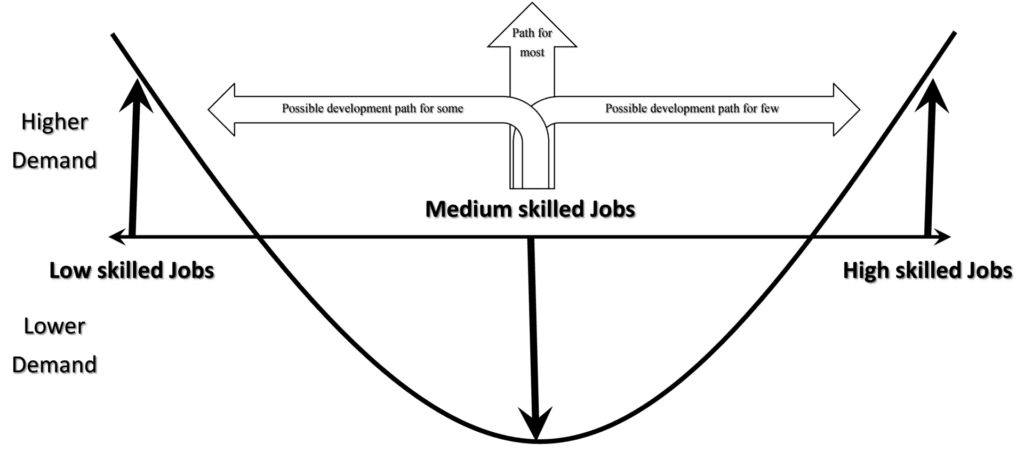
In the medium term e.g. 510 years we will see the full effect of the Information and Communication Key Enabling Technology development. The principle is outlined in Figure 3 (Roos, 2014c).

Figure 1: Changing demands for jobs across the skills spectrum (Roos, 2014c)


The key challenge is the increasing demand for individuals with all three skill sets:

• Interpersonal skills

• Creative problem solving ability

• Domain expertise

This demand is found at both extremes of the skill scale e.g. in the need for a cleaner who has to clean an office that is in use, and in a submarine designer who has to create a solution to a problem never before encountered within a complex stakeholder interaction framework.

Almost all of the jobs in the middle will disappear due to: the increasing speed and capacity of computer hardware; the increasing availability of data due to digitization and development of sensors that can deliver just in time information; and to the development of algorithms that enable information to be turned into useful data. This development will have a dramatic impact on service jobs and primarily backoffice type jobs in e.g. law firms and accounting firms. Today processes like discovery, that take thousands of hours in complex legal cases with millions of pages to digest, can be done in seconds by a computer that has been trained by an experienced discovery professional across the first 10 or so documents. The result will be a reduction in backoffice staff of lawfirms of 90% or more, whilst the star lawyers arguing the case in front of the court will become even more productive and the concierge that services them when in the office will be even more sought after – an illustration of the demise of the middle and the growth of the two extremes. Not only will this kill any hope of the emerging service economy being a large employer that provides decent salaries, it will also generate a major social problem for societies: many countries have in place a policy to increase the number of people with university education, but the universities are currently educating in only one of the three required skill domains, i.e. domain expertise. Historically driven «highstatus» professions like law and accountancy will be lowvolume employers in tomorrow’s world. The few who succeed will be at the top of their class with an innate capability in the domains of creative problem solving and interpersonal skills providing them with a potential to reach the top of their chosen profession.

This university education policy is likely to generate a large number of individuals with no job and high study debts. Some of these may be able to migrate into the lower end of the skill scale but the corresponding oversupply of individuals will generate an increasing downward pressure on salaries for those who do get a parttime job serving coffee to visiting tourists.

The impact on the primary industry domain and the manufacturing domain will be less, due to their already lean operations with high productivity, but there will still be some impact in terms of the peopleless mines, the robotic precision agriculture facilities and the constant reduction of employees in manufacturing based on productivity increases outstripping demand growth in the served markets, exacerbated by the replacement of labour by capital equipment leading to most scale intensive industries moving to become «black factories» i.e. peopleless 24/7 production operations.

So what will all these people do and how will society respond to this?

Firstly there is a need to have as many startups as possible in the firm domain and to support the growth of these startups as much as possible. This is not primarily because they will generate employment but rather that they will generate an economic surplus that can be taxed and economic transactions that can be taxed by government as a rev enue source. Revenue raising will be critical and should focus on the two forms of tax that cannot be moved offshore, i.e. consumption tax and tax on fixed assets.

Secondly, any country with a resource base (e.g. oil, minerals, hydroelectric or geothermal energy, agricultural land etc.) has to ensure that it has an effective resource rent tax (like the Norwegian Sovereign Wealth fund that now stands at around one trillion dollars) and also strong incentives to add preexport value to produced goods for tax purposes (like Sweden’s value adding to iron ore and trees, or Iceland’s attraction of energy intensive production like e.g. aluminum smelting based on its very low cost geothermal energy).

Thirdly, education has to be adapted to produce graduates at all levels with the required three skill sets to ensure maximum local employment.

For the rest there will be unemployment or selfemployment that has to be guaranteed on a low but acceptable income level to avoid social unrest.

If the above reasoning sounds pessimistic, please bear in mind that I have not discussed here the implications of each of the other Key Enabling Technologies which will all have different impacts but with the same general effect on society.

Conclusion

Over the period to c. 2030 (known as the «singularity» because that is when it is estimated that computers will become selfaware, with a reasoning capacity exceeding that of human beings) we will see technologydriven shifts in our societies unlike anything seen so far.

These shifts will create threats and opportunities but these will not be symmetrically distributed across society and scales. On the firm level they will be balanced towards the opportunity side. On the level of the individual they will, with few exceptions, be balanced towards the threat side. On the society side there will be a large difference depending on whether the society has access to key resources and whether it has a highly complex economy – if it has, then this will provide an opportunity to handle the upcoming challenges with a low probability of social unrest; but if it has neither of these, then the society risks major instances of social unrest with the associated negative outcomes.

It is paramount that our political masters start to discuss these issues while there is still time.

Written by Prof. Göran Roos


Innovative Finance, a new discipline that investors, companies and government should know about

Innovative financing is a combination of something new and a new framing of activities that have existed for a long time. Perhaps the most important and surprising thing about Innovative Finance is that it is not financial innovation. The «innovation» aspect of innovative financing lies in the introduction of new products, the extension of existing products to new markets, and the presence of new types of investors.

For more than a decade, microfinance has been the poster child of finance in developing countries. In the decade to come, we believe that innovative financing, which identifies ways to achieve social, environmental, and financial returns; will be the most important new source of development finance. In Spain this is a significant opportunity both for companies and investors to engage in emerging markets. The emergence of this asset class will trigger a new domestic dialogue between the private sector and Government in Spain about how to invest in better public services and new growth engines in the economy. By paying more attention to the innovations that occur in newer economies, we in Europe can provide better returns for our businesses and better lives for our citizens.

This article first presents the background for innovation finance and its definition. We then offer some perspectives on the size and future of innovative finance. Finally, we will suggest different avenues on how Spanish companies can engage in the arena.

Why Innovative Finance? 

Imagine not having access to essential livesaving health products. Severe pneumococcal disease – primarily pneumonia and meningitis – is the leading vaccinepreventable cause of death in children under five. The most effective way to prevent these deaths is to ensure that all children have access to a safe, affordable vaccine. Despite the widespread availability of the vaccine in North American and Europe, appropriate vaccines were not available in developing countries prior to the introduction of the Pneumococcal Advanced Market Commitment.

In June 2009, the governments of Italy, the United Kingdom, Canada, the Russia Federation, Norway and the Bill & Melinda Gates Foundation launched a new innovative financing product, the Pneumococcal Advanced Market Commitment, to increase supply and reduce the price for pneumococcal vaccines. As a result, it is estimated that the pilot can prevent more than 1.5 million childhood deaths by 2020 1.

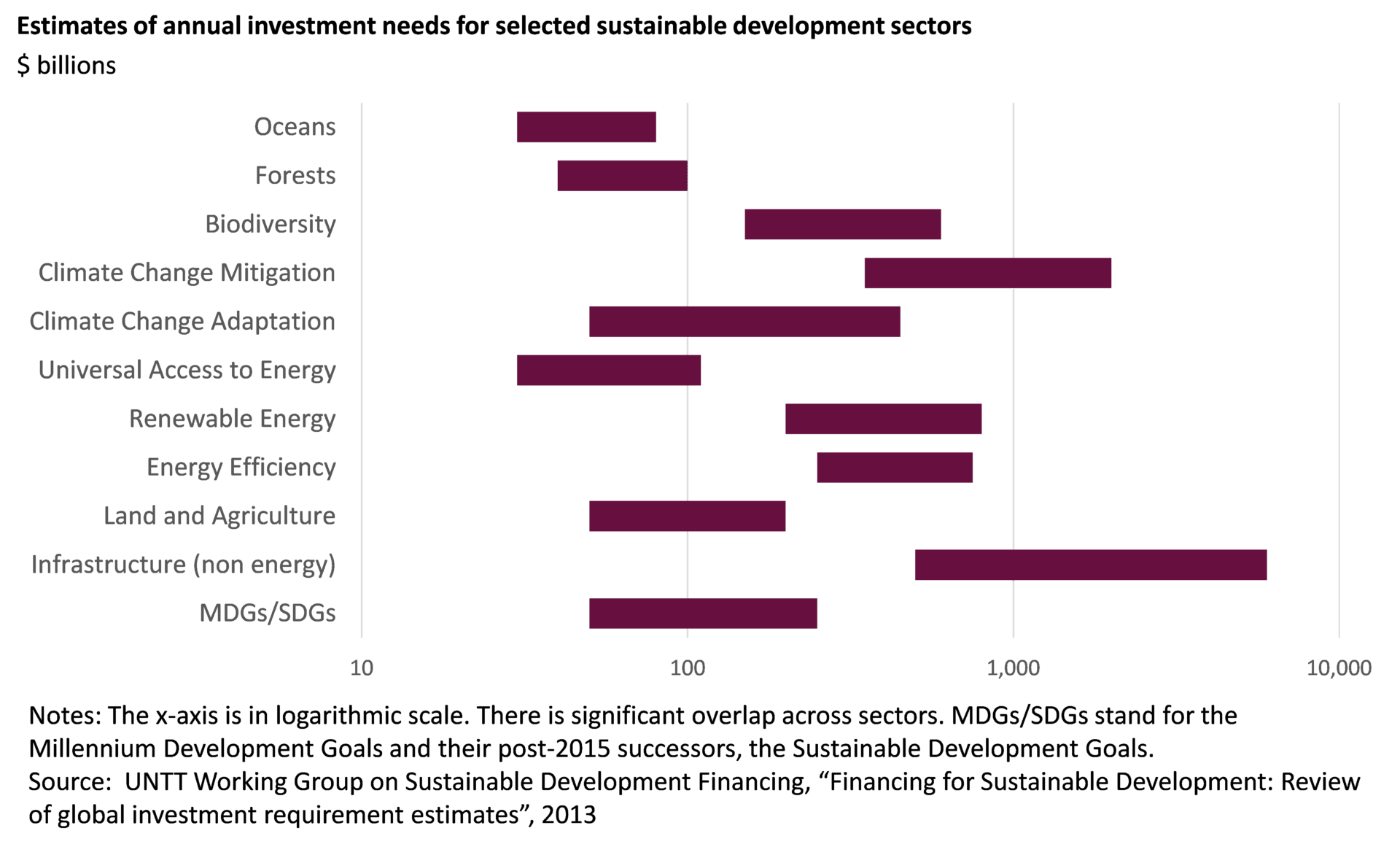
The growth in innovative finance has been born out of both demand and supply side needs. On the demand side, particularly three streams have been important: a) Fighting poverty and climate change requires additional massive investments; b) Meeting the demands of growing middle class families that want reliable energy supply and quality health and education now and not in years to come; and c) Finding new ways to supplement government budgets that have been shrinking after the financial crisis. If we take a look upon the first item, then it is estimated that dealing with climate change and meeting the Millennium Development Goals and its successor will require additional one trillion dollars a year 2. The public sector does not have the resources to support all of these needs alone.

Figure 1: A successful transition to sustainable development will require substantial resources 

Estimates of annual investment needs for selected sustainable development sectors $ billions

On the supply side, it has particularly been two drivers behind the interest in innovative finance. The first and most important one has been the continued low interest rates in OECD countries. Large pension funds and other institutional investors with large holdings in bonds are increasingly on the lookout for alternative investment options that have a longterm, secure, yield. The second driver has been the growing recognition by the private sector of the rewards of promoting economic and social prosperity and environmental sustainability through their operations. For example, the 1200 signatories of the United Nationssupported Principles for Responsible Investment Initiative – including asset owners, investment managers, and service providers – have today $34 trillion dollars in assets under management 3.

What is innovative finance and what benefits does it bring? 

Like most other advances, innovative financing is a combination of something new and a new framing of activities that have existed for a long time. Perhaps the most important and surprising thing about Innovative Finance is that it is not financial innovation. The «innovation» aspect of innovative financing lies in the introduction of new products, the extension of existing products to new markets, and the presence of new types of investors. The term refers to a broad range of financial instruments and assets including securities and derivatives, resultsbased financing, and voluntary or compulsory contributions that by design and in a combination both serves public and private goals.

Case Study: Green Bonds 

Green bonds provide an instrument through which investors who are concerned with the effects of climate change can make a difference by specifically supporting climate change related projects.

The World Bank first issued green bonds in 2008 to finance investments in lowcarbon infrastructure, such as renewable energy infrastructure and energy efficiency improvements. In the past five years, green bonds have grown considerably. According to Standard & Poor, government and corporations issued $10.4 billion in green bonds in 2013. A recent report by Bloomberg New Energy Finance points out that the market is growing fast; at its current pace, total volume of green bonds will surpass $40 billion by the end of 2014.

What is intriguing about innovative financing is that it can close some very important market gaps. Successful innovative financing instruments address a specific market failure, catalyze political momentum to increase and coordinate the resources of multiple governments, and offer contractual certainty to investors. Often, innovative financing instruments reallocate risks from investors to institutions better positioned to bear the risk and, in the process, enable participation from mainstream investors. Instruments that have mobilized significant resources benefit from relatively simple financial structures and a proven track record that clearly describes the financial and social returns for investors.

How does innovative financing create value?

• Deploys significant, new private sector capital that would otherwise not par-ticipate in social investments.

• Transforms financial assets through financial structuring and intermediation to meet the needs of development programs by distributing risk, enhancing liquidity, reducing volatility, and avoiding timing mismatches.

• Supports a cooperative public-private sector approach to scale socially benefi-cial operations that require significant capital outlays and traditionally sit squarely in the realm of the public sector.

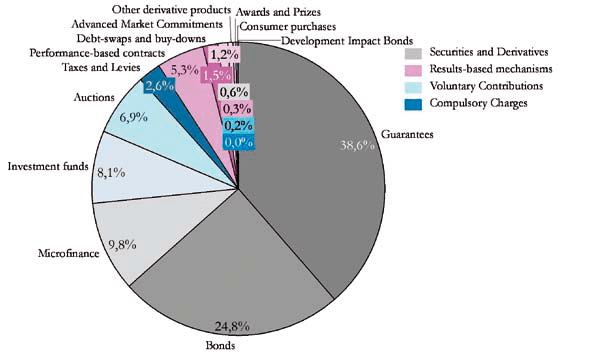
Figure 2: Bonds and guarantees are the largest innovative financing mechanisms 

Amount mobilized by innovative financing mechanisms, 200-2013


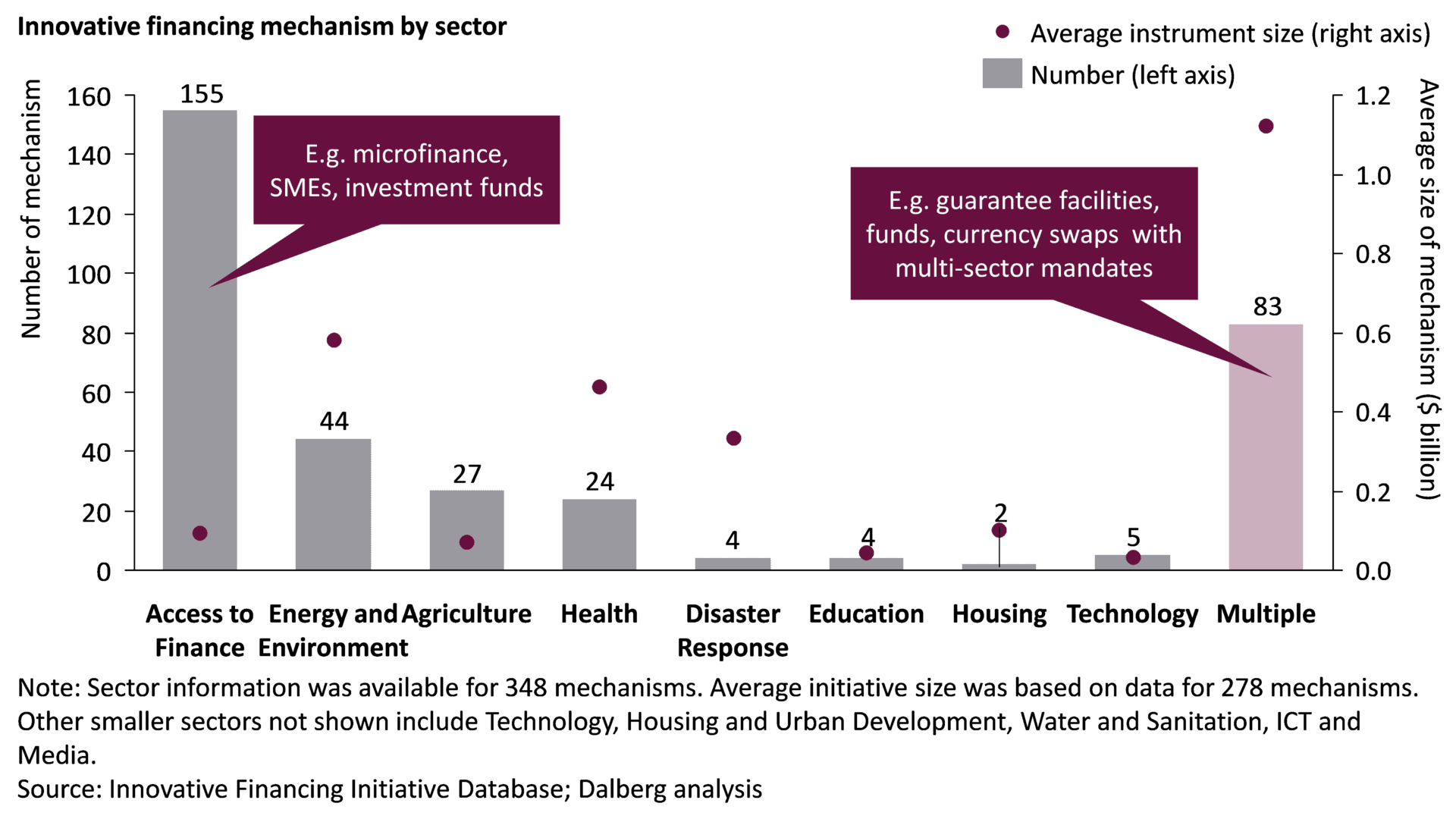
Dalberg Global Development Advisors conducted a survey of nearly 350 financing mechanisms that have been recognized as innovative financing. We estimate that innovative financing instruments have mobilized nearly USD 100 bn since 2000 and grown at 11% per year between 2000 and 2013. More than 80% of this total comes from securities and derivatives such as bonds, guarantees [Figure 2]. The proceeds of these investment support increased access to finance, investments in sustainable energy, and improvements to agriculture productivity [Figure 3].

Figure 3: Innovative financing mechanisms have focused on a range of development challenges 

Innovative financing mechanism by sector

What is the implication of this in Spain? 

We believe that there are at least two important lessons that can be used in a Spanish context. First, companies and institutional investors that target returns in emerging markets must be capable of applying innovative financing approaches to their activities. Spanish companies that are involved in infrastructure projects or desire to serve mass markets must be able to design value propositions that resolves the issue that few public or private customers can pay for major services and investments up front, but have an ability to pay overtime in smaller pieces. Moreover, Spanish providers will also need to find ways to unlock additional value by providing goods and services that there is a public interest (domestic or overseas) to subsidize because it also has large society benefits. For investors that are interested in a different posture and exposure, then innovative finance has the attraction of providing a flow of alternative investments that can combine solid underlying assets with often strong risk adjusted returns because they involve services in great demand as they are centered on basic human needs.

The second lesson is that the Government of Spain with its stress on the public finances should take a hard look at innovative finance and the publicprivate projects that today are being developed in emerging markets. To create new growth opportunities and jobs in the private sector, the public sector needs to play a new role. It needs to move away from being the key driver of new growth activities to facilitating and incentivizes new investments through private sector partnerships. An inspiring example is Estruturadora Brasileira de Projetos (ESP) in Brazil that is coowned by 5 commercial banks. They have successfully set up a publicprivate partnership entity to develop new airports, harbors, roads and other critical infrastructures. This entity has become a factory of large scale infrastructure projects that rests on strong commercial business cases and clear society needs and benefits.

What makes innovative finance different from other initiatives and tools in social and economic development is its scalability. While many efforts are bound by governments or philanthropists’ pockets or conflicting incentives for businesses, this method enables players to bring their core competences and assets to the table and engage in activities that often are close to limitless in their scale or replication.

Written by Sam Lambert and Henrik Skovby, DALBERG.


1. See more at: http://www.gavi.org/funding/pneumococcal-amc/about/ 

2. These estimates are based on the literature review found in «Financing for sustainable development: Review of global investment requirement estimates», UNTT Working Group on Sustainable Develo¬pment Financing, 2013. 

3. See http://www.unpri.org/about-pri/about-pri/ for more information (accessed June 2014).   

Why Servitization is an increasingly critical strategy for manufacturing firms

Servitization is increasing rapidly and is likely to continue to do so since both the defen¬sive and offensive drivers of servitization are increasing in strength. The increasing im¬portance of servitization as a business model innovation strategy for manufacturing firms is unfortunately made difficult by the both complicated and complex journey that is in¬volved in successfully implementing this servitization strategy resulting in a not insig¬nificant failure rate. On the positive side the opportunities are extensive and increasing as relates to offering services throughout the value chain but care has to be taken to ensure that the manufacturing firms’ business model is modified to ensure profitability with the implemented service activities.

Servitization can be understood as all service concepts, systems service, processes and related service activities offered and carried out by, or behalf of, a manufacturing firm linked to the products produced by this firm. This means that without the manufactured product there exist no services i.e. servitization is an integral part of manufacturing.

What are the drivers of servitization?

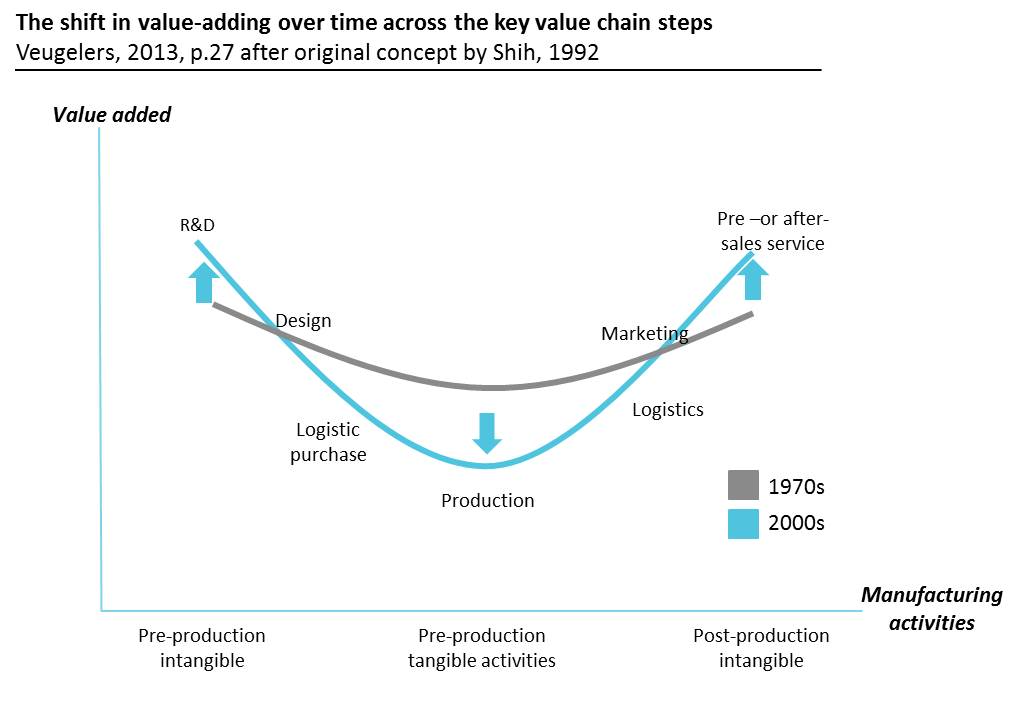
The principle driver can be outlined using the figure below:


This figure illustrates the change in the potential to add value to the different parts of the manufacturing firm’s value chain. As can be seen from the above figure the value adding potential is migrating from the production activities to the pre- and post-pro¬duction activities of the manufacturing firm. As a consequence the manufacturing firm needs to increase/extend its pre- and post-production activities to keep the total value adding stable. This is the fundamental reason for the increasing importance of servitiza¬tion as a strategy for manufacturing firms.


The reduction of the potential value adding in the production part of the manufacturing firm’s value adding activities is further reduced by the disintermediation of the value chain enabled by the reduction of coordination cost made possible by the development of ICT technology which is making it possible to benefit from migrating production activities to lower cost jurisdiction. This development can clearly be seen by the fact that the majority of world trade is made up of intermediate goods. Although the continuous technological development in domains like internet-of-things, production systems for high cost countries and additive manufacturing may contribute to a concentration of the value chain back to high cost countries they will also contribute to further lowering of the value adding potential in the production part of the manufacturing firm’s value add¬ing activities.

This will increase the pressure even further on manufacturing firms to enter the pre- and post-production activities which is the domain of service delivery. It is worth noting that as the knowledge underpinning services in these areas become commoditised and as the digitalisation of these services increase and as the underpinning manufactured products and digital communication protocols get increasingly standardised, and as the interaction becomes increasingly machine-to-machine rather than person-to-person – the competi¬tive pressures on the associated services will increase thereby both reducing margins and opening for a disintermediation of the service delivery value chain parts analogous to what has already happened to the production part of the value chain.

This means that not only does the manufacturing firm have to servitize to compensate for the continuous reduction in value adding potential relating to production activities, they will also have to create service monopolies generated by product attributes that lock com¬peting service providers out as well as by continuously innovating also in the domain of services. This will enable temporary competitive advantages for the manufacturing firm with the resulting high economic rent. In summary the manufacturing firm will compete on value for money in a market where it ideally is the only service provider able to provide services associated with a given product manufactured by the manufacturing firm as well as the highest value-for-money provider of integrated product-service-systems or solutions in competition with other providers of competing product-service-systems or solutions.

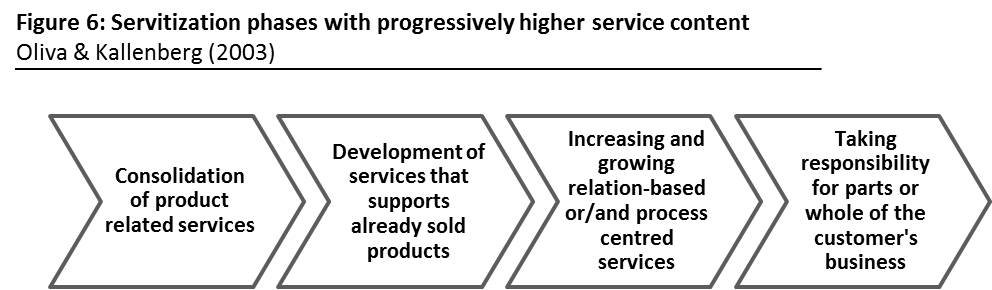
Oliva &. Kallenberg. (2003) described the servitization journey as a sequence of phases with increasing service content (see the figure below)


Every step to the right in the figure above requires a change in the organisation, culture, processes and customer interaction as well as the development of new competencies and capabilities. One of the fundamental requirements is for employees in the servitized manufacturing organisation to gain a deep insight in the customers, their issues and how they create value for and appropriate value from their customers. This in order for the servitized manufacturing firms to be able to develop services that enhances the customers’ business by leveraging this insight and close customer relationships with a guiding phi¬losophy of enhancing the customers’ business.

Servitizing manufacturing organisations have to create support systems and organisa¬tional structures suitable for service innovations originating in the interaction with customers. Normally this involves a simple process supporting the solving of a specific customer problem followed by a clear development process encompassing methods and ways of working focussing on modifying existing resource deployment systems, cus¬tomer experiences and business models that supports the transformation of this cus¬tomer specific service into a generic service that can be offered to many customers.

Ren (2009) concluded that products that are cheap and that are of a stand-alone nature (in either their nature or in how they are deployed) provide few opportunities for service offerings whereas expensive or complex to operate products that are part of a larger in¬tegrated system that is critical to the customer’s business provide substantial opportuni¬ties for service provision. He also said that when firms servitize they expand their offerings into (Ren, 2009):

  • Equipment focussed product life cycle offerings including maintenance services. The activities that the user or customer typically execute that forms the basis for service opportunities are need recognition, product specification, supplier selection, purchase transaction, delivery, installation, training and ongoing support. Given the long lifecycle of B2B capital goods and the critical nature of this good to the user’s or customer’s activities there are considerable opportunities for service offerings in the ongoing support domain. When the customer procures and uses more than one piece of a given equipment offering, the ongoing support tends change characteristics and becomes on-site maintenance.
  • Asset focussed managed services. Assets are a system made up of different pieces of equipment, purchased from different suppliers at different points in time but inter¬linked and/or interdependent in their use. This creates a higher level of complexity than dealing with a given piece of equipment and when the complexity level becomes sufficiently high users normally establish a dedicated organisational function to man¬age the assets and to coordinate any support activities. This provides an opportunity for servitizing manufacturing firms to enter the area of managed services where they would take over this function and offer maintenance, equipment replacement, op¬eration and asset optimisation, etc.
  • Process focussed advisory or consulting services. When putting the equipment to use with a specific intent the user may need technical advice, management advice as well as both proactive problem solving (i.e. co-innovation) as well as reactive problem solving. This provides opportunities for servitizing manufacturing firms to offer chargeable advisory or consulting services or to migrate all the way, given sufficient understanding of their customer’s/user’s world, to offering solutions and even to implement these solutions using their own monetary resources, their own equipment and other physical assets, their own relationships, their own competence embodies in their own people and processes, their own brands and any other resources that the servitized manufacturing firm can bring to bear.

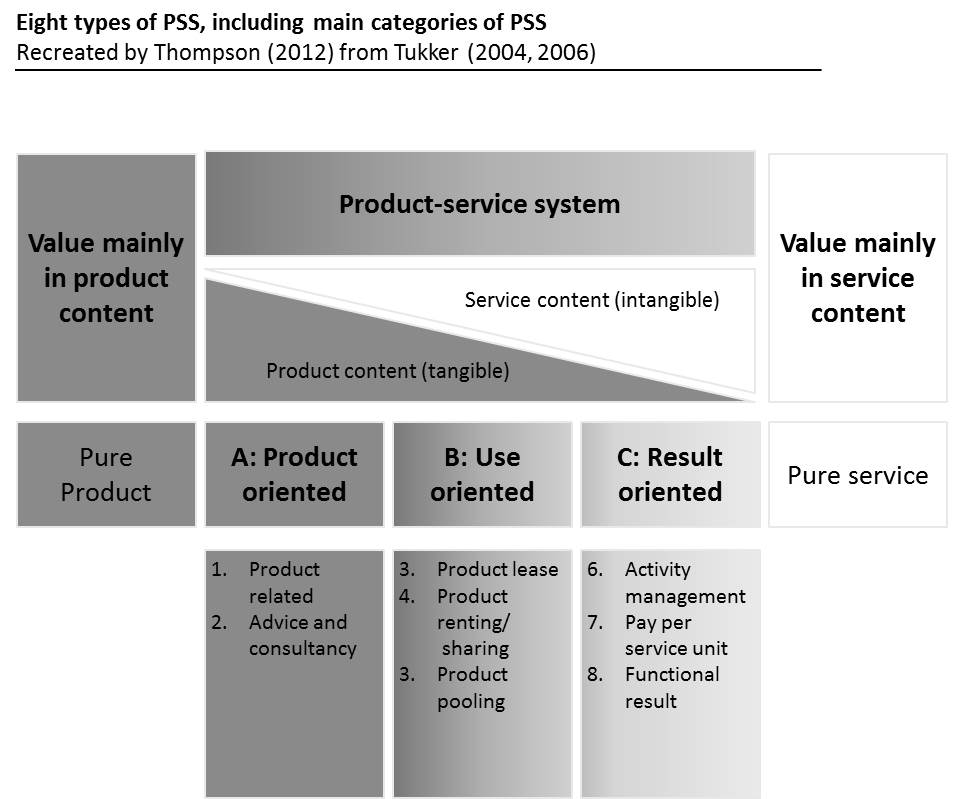
This author built on the work by Tukker (2004) who identified eight types of product-service-systems, which he divided into categories and presented on a product-servico continuuem as shown in the figure below:


As well as on the work by Neely (2008) who added two new categories to the Tukker classification:

  • Integration-oriented product-service-systems, which result when firms seek to add services by going up- or down-stream and vertically integrating (e.g. consulting ser¬vices, financial services, retail and distribution, transportation and trucking services and property and real estate services)
  • Service-oriented product-service-systems, result when firms incorporate services into the product itself (e.g. systems and solutions)

As a conclusion, we can say that the forces that drive manufacturing firms to servitize are many and they are as a group becoming stronger. This means that the imperatives to servitize are becoming stronger. For those manufacturing firms that have not yet ser¬vitized it means that they have to embark upon a servitization strategy within the not too distant future and for those that have already started their servitization it means that they are likely to have to increase the speed by witch this strategy is implemented as well as likely broaden its offering scope.

Since in both situations this means doing something not done before, servitization is an innovation and since it changes the way in which the firm creates and appropriates value it is a business model innovation.

Like all innovations servitization involves risk and in order to minimise this risk numer¬ous challenges have to be recognized and overcome.

* Göran Roos es Chairman, Advanced Manufacturing Council and Professor